
Instructional Materials
LIFT is a district-wide grant-funded, three-year program that brings together components of Strong Foundations, Texas Instructional Leadership, and Texas Lesson Study to provide comprehensive support for districts adopting high-quality instructional materials (HQIM) and implementing Bluebonnet Learning. LIFT blends HQIM implementation and instructional leadership support together to create effective and sustainable learning environments for all students.

LIFT supports the sustainable implementation of HQIM using aligned tools and strong systems. LIFT begins with a needs assessment to evaluate a school system’s individual requirements, and across three years, LIFT customizes programming to the needs of each school system.
Learn about LIFT
LIFT has various pathways to meet each individual school system's needs and many benefits for all participants.
-
Application Entry Points
When school systems apply for the Learning Acceleration Support Opportunities (LASO) grant and are awarded funds, they will enter LIFT in one of two entry points based on their instructional readiness. A specific entry point determines whether a district begins with planning or implementation.
Planning Entry Point | A school system is preparing to adopt HQIM.
A school system is interested in adopting State Board of Education (SBOE)-approved HQIM and applying to LIFT for the planning year, and:
- Commits to selecting and implementing HQIM in the 2027–28 school year,
- Has not yet adopted Bluebonnet Learning, and
- Will undergo a needs assessment to customize their experience.
If, after the planning year, the school system determines that Bluebonnet Learning is not the right fit, they will transition out of LIFT.
Implementation Entry Point | A school system is implementing a Bluebonnet Learning product.
A school system has already adopted Bluebonnet Learning and is applying to LIFT for the implementation year, and:
- Commits to implementing Bluebonnet Learning in the 2026–27 school year,
- Has completed instructional materials selection and is preparing for rollout, and
- Will undergo a needs assessment to customize their experience.
-
Bluebonnet Learning Instructional Materials Support
LIFT will support all Bluebonnet Learning instructional materials that are SBOE-approved.
SBOE-Approved Instructional Materials:
- Bluebonnet Learning K–3 Foundational Skills, Edition 1
- Bluebonnet Learning K–5 RLA, Edition 1
- Bluebonnet Learning K–5 Math, Edition 1
- Bluebonnet Learning Secondary Mathematics, Edition 1 (including Grades 6–8 and Algebra I)
IMRA 2025 Instructional Materials*:
- Aprendizaje Bluebonnet Spanish Artes del lenguaje y lectura K–5
- Aprendizaje Bluebonnent, Destrezas fundamentales K–3
- Aprendizaje Bluebonnet Matemáticas K–5
- Aprendizaje Bluebonnet Matemáticas de Secundaria, Grade 6
- Bluebonnet Learning Secondary Mathematics, Edition 1 (Algebra II and Geometry)
*The SBOE is expected to meet in November to approve, reject, or take no action on instructional materials submitted in IMRA 2025. If the instructional materials are approved, LIFT will support them in the 2026–27 school year.
-
LIFT Benefits
School systems that participate in LIFT receive:
- Support in adopting and implementing HQIM, including technical assistance for planning and training teachers.
- Instructional leadership development coaching, feedback cycles, and schoolwide routines aligned to research-based instructional strategies (RBIS).
- Capacity-building for sustainable systems-level change, including performance management systems, and district-level instructional frameworks.
- Dedicated, sustained funding and access to vetted, approved providers that support implementation and accelerate student learning with grants, for up to three years.
-
Multi-Year Support Pathways
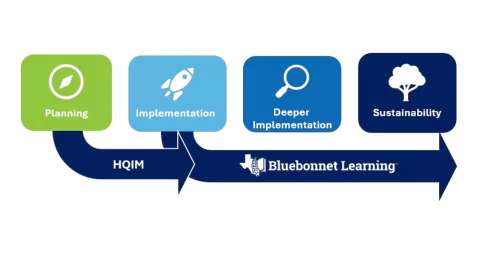
If awarded the LIFT grant, a school system will begin with a needs assessment to understand current instructional systems and materials. School systems will receive tailored support through various pathways based on the needs assessment and the school system's instructional readiness.
Each pathway is designed to guide a school system through a multi-year process of building sustainable instructional systems and implementing HQIM.
Pathway 1: Starting Out
School systems that have not previously adopted HQIM and are interested in adopting HQIM* and/or Bluebonnet Learning will be considered Starting Out and will likely go through the following three phases:
- Planning
- Implementation
- Deeper Implementation
*School systems that adopt HQIM other than Bluebonnet Learning are only eligible for the planning year of LIFT.
Pathway 2: Ready to Implement
School systems preparing to implement Bluebonnet Learning instructional materials for the first time in the 2026–27 school year and are applying to LIFT for the implementation phase will be considered Ready to Implement and will likely go through the following three phases:
- Implementation
- Deeper Implementation
- Sustainability
Pathway 3: Currently Implementing
School systems that previously engaged in Strong Foundations Implementation in the 2025–26 school year for Bluebonnet Learning K–5 Reading Language Arts (RLA) and K–5 Math instructional materials and plan to continue implementation in the 2026–27 school year will be considered Currently Implementing and will likely go through the following three phases:
- Implementation
- Deeper Implementation
- Sustainability
The Texas State Literacy Plan (TSLP) was funded by the Comprehensive Literacy State Development Grant. The TSLP was developed by stakeholders across the agency highlighting work that is ongoing to support education service centers, districts and campuses in improving their language and literacy instruction practices to support student literacy development.
The TSLP focuses on interlocking systems of support based on the science of reading and learning. These systems of support encompass high-quality early literacy supports, high-quality instructional materials and student supports, high-quality professional development and leadership support to maximize literacy instruction and to propel Texas to become the state with the highest literacy rates in the United States.
View the Texas State Literacy Plan for 2025 (PDF).
The Local Classroom Review process establishes a local school system’s instructional materials review process under House Bill (HB) 1605, Texas Education Code (TEC), §31.0252.
Local Classroom Reviews will evaluate the degree to which instructional materials in classrooms correspond with the instructional materials adopted by the school district or district campus. Additionally, this process ensures the instructional materials meet the level of rigor outlined in the Texas Essential Knowledge and Skills (TEKS) adopted for the grade level in which it is being used, per TEC §28.002.
Local classroom reviews will be conducted by reviewers certified by the TEA. After the review, TEA will provide a local classroom review report to the school system.
Local Classroom Review Request Process
Parents can submit an individual request to review instructional materials in accordance with local policy or procedures. Parents may also submit a petition, according to statutory requirements, to the local school board for a local classroom review as described in §26. 0061.Parents can request a local classroom review through their local school systems beginning September 1, 2025, per §67.69.
During the April 2025 meeting, the SBOE approved §67.69, which outlines process requirements to support parents in requesting local classroom reviews. School districts and charter schools must establish a process for parents to request a local classroom review of instructional materials for their child's grade level under Texas Education Code §31.0252. This process must include guidelines for petition submission, align with the statewide submission window, and require the board to consider petitions at the next regular meeting following submission. Additionally, it must detail the required information for petitions and establish an appeal procedure for denied petitions, including steps, criteria, and timelines for appeals, per §67.69.
School districts and open enrollment charter schools can also request a district wide local classroom review by submitting a request to the Texas Education Agency (TEA) beginning September 1, 2025.
The school system is not required to conduct a local classroom review in an individual classroom more than once a school year.
Local Classroom Review Cost
Parent-initiated requests, approved by the district, will be prioritized and conducted at no cost to parents as long as funding is available.
School district requests for districtwide reviews of local classroom instructional materials will be conducted with grant funds as long as they are available. Once grant funds are exhausted, districts may continue to submit districtwide requests with the option to use local funds to conduct the reviews.
Rubrics
Local classroom review rubrics will be used to determine whether assignments are on grade level. The SBOE approved four rubrics for local classroom reviews during their April 2025 meetings. Prior to SBOE approval, the rubrics were available for public review and feedback.
The instructional materials that can be reviewed through this process are aligned to the Instructional Materials Review and Approval (IMRA) rubric development schedule and review cycles. As such, local classroom reviews for the 2025–26 school year could take place in classrooms that teach the following
- ELAR K–3 Foundational Literacy Skills Rubric | Approved April 11, 2025
- ELAR K–3 Reading Comprehension Rubric | Approved April 11, 2025
- ELAR 4–8 Reading Comprehension Rubric | Approved April 11, 2025
- Mathematics K–12 Rubric | Approved April 11, 2025
Webinars
Table scrolls horizontally on small screens.
| Overview for Local Education Agencies |
|---|
| Local Classroom Reviews — Overview for Local Education Agencies (PDF) |
| Local Classroom Reviews — Overview for Local Education Agencies Webinar (Recording) |
Table scrolls horizontally on small screens.
| Overview for Parents |
|---|
| Local Classroom Reviews — Overview for Parents (PDF) |
| Local Classroom Reviews — Overview for Parents (Recording) |
Local Classroom Reviewers
Table scrolls horizontally on small screens.
| Resources for Local Classroom Reviewers |
|---|
| LCR Reviewer User Guide (PDF) |
| Login and My Dashboard (Video) |
| Reviewing & Scoring Assignments (Video) |
| Submit & Finalize Your Review (Video) |
LEAs can review available high-quality instructional materials (HQIM), including Bluebonnet Learning instructional materials, and explore resources and guidance for ordering materials using the EMAT system.
Procure Instructional Materials in EMAT
Find information and resources about instructional materials funding, EMAT access, and more.
Instructional Materials Funding
Explore instructional materials funding allotments and HB 1605 entitlements.
Bluebonnet Learning Instructional Materials
Learn about the state-developed, SBOE-approved instructional materials designed for Texas students.
Review and Approval Processes
The Instructional Materials Review and Approval (IMRA) process is the new procedure the SBOE uses to review instructional materials for quality, suitability, and alignment with state standards. Resources and relevant information about the former review process can be found on Proclamations.
Learn about House Bill (HB) 1605 and the IMRA process.
Find information and resources for the current and past IMRA cycle, reviewers, and publishers.
Review relevant documents from the former review process, from Proclamation 2014 to 2024.
Related Resources
Information about adopted instructional materials, district allotments, and various EMAT reports.
Strong Foundations Planning (SFP) provides direct grant funds to local educational agencies (LEAs) for technical assistance to develop a strong instructional framework in math or literacy based in the research-based instructional strategies (RBIS) to guide teaching and learning in the LEA.
Grant Information
Eligible applicants are LEAs. LEAs that previously participated in the Strong Foundations Framework Development Grant in school year (SY) 2022-2023 and/or Strong Foundations Planning Grant in SY2023-24 and/or SY2024-2025 are NOT eligible to apply for the same content area awarded in previous grant cycles. Prior grantees are eligible to apply for a new content area.
LEAs looking for support in the following areas are the best fit for grant application:
- High-quality professional learning (HQPL) on math or literacy RBIS
- Support in developing an instructional framework in math or literacy to guide key decisions about teaching and learning
- Diagnostic of the current state of instructional materials and instruction
- Support in developing an instructional framework rollout plan and deciding whether to adopt high-quality instructional materials (HQIM) to achieve the instructional goals
In SFP grants, LEAs are required to use:
- Fifty percent (50%) of grant funds to contract with a single, approved provider from the LASO Cycle 3 state-approved provider list for SFP to support grant activities.
- Twenty percent (20%) of grant funds for additional support from the approved provider and/or salaries or partial salaries for project managers, instructional coaches, or other positions directly supporting grant activities.
-
Thirty percent (30%) of grant funds for other allowable expenses, (e.g., print materials, digital licenses, teacher stipends, instructional coaches).
For information about eligibility requirements, resources, funding, and timelines, review LASO Cycle 3.
Strong Foundations Implementation (SFI) provides direct grant funds to local educational agencies (LEAs) for technical assistance to support high-fidelity implementation of the Bluebonnet Learning instructional materials, including high-quality professional learning (HQPL) for teachers, coaches, school leaders/campus administrators, and district leaders on effectively implementing Bluebonnet Learning. Strong Foundations Implementation is the OER Instructional Material Support program established by Chapter 31 of the Texas Education Code.
Grant Information
Eligible applicants are LEAs implementing approved, core instructional materials in school year 2025–26.
Approved, core instructional materials pending approval by the State Board of Education (SBOE) through the Instructional Materials Review and Approval (IMRA) process include:
- Bluebonnet Learning K–5 Reading Language Arts, Edition 1
- Bluebonnet Learning K–5 Math, Edition 1
- Bluebonnet Learning Secondary Mathematics, Edition 1 (Grades 6–8 and Algebra I)
Additional, pilot-approved core instructional materials include:
- Aprendizaje Bluebonnet Artes del lenguaje y lectura K-5, Edición 1
- Aprendizaje Bluebonnet Matemáticas K–-5, Edición 1
In all SFI grants options, LEAs are required to use:
- Fifty percent (50%) of grant funds to contract with a single, approved provider, per instructional material from the LASO Cycle 3 approved provider list for SFI to support grant activities (it is highly recommended that LEAs contract with the same provider for all instructional materials).
- Twenty percent (20%) of grant funds for additional support from the approved provider and/or salaries, or partial salaries, for instructional coaches or other positions directly supporting implementation of the instructional materials.
- Thirty percent (30%) of grant funds for other allowable expenses, (e.g., print materials, digital licenses, teacher stipends, instructional coaches, approved assessment platforms).
For information about eligibility requirements, resources, funding, and timelines, review LASO Cycle 3.
ESC Strong Foundations Implementation Support provides professional learning directly to teachers, coaches, and leaders through asynchronous modules and live virtual or in-person job-embedded supports delivered by Education Service Centers (ESCs).
It provides flexibility to customize for local implementation needs, monthly 1:1 planning, implementation supports for leaders, an option for in-person supports, asynchronous modules and live virtual supports, and job-embedded supports and coaching sessions to provide individualized supports for teachers, coaches, and leaders.
Planning and Progress Monitoring Supports
Pre-implementation planning prepares districts for the high-fidelity implementation of instructional materials. During pre-implementation planning, districts receive differentiated supports based on an implementation readiness assessment of system- and school-level assurances (e.g., following the year-long scope and sequence, meeting the minimum number of instructional minutes, using the curriculum-embedded assessments, providing access to print and digital materials, ensuring sufficient planning time). Supports include 1:1 consultations to provide targeted technical assistance.
During the school year, leaders will engage in check-ins focused on monitoring implementation progress through cycles of continuous improvement.
High-Quality Professional Learning (HQPL)
Onboarding and ongoing HQPL is provided directly by ESCs to leaders, coaches, and teachers.
- District leaders will participate in 12–18 hours of live trainings focused on the planning and implementation of the instructional materials, as well as participate in communities of practice with district leaders across the state. District leaders will also receive monthly planning and implementation support from ESC staff.
- School leaders will participate in 18–24 hours of live trainings focused on the planning and implementation of the instructional materials, as well as participate in communities of practice with other school leaders in the district. School leaders will also receive implementation coaching from ESC staff.
- Coaches will participate in 18–24 hours of self-paced asynchronous learning modules focused on the implementation of the instructional materials, as well as receive live virtual or in-person coaching from ESC HQIM experts to build capacity to support teachers.
- Teachers will participate in 18–24 hours of self-paced asynchronous learning modules focused on the implementation of the instructional materials, as well as receive live virtual or in-person job-embedded supports from ESC HQIM experts and LEA staff (e.g., ESC staff facilitates a lesson internalization with a PLC, ESC staff conducts a co-observation and co-debrief with a LEA coach or leader).
Senior district leaders (e.g., Superintendents, Chief Academic Officers, Chief School Officers) will also join monthly live virtual communities of practice.
Data Collection
TEA collects data to inform the continuous improvement of instructional materials and implementation supports. Data collection includes 15-minute surveys for leaders, coaches, and teachers throughout the year. Coaches and teachers will also submit additional 15-minute surveys on protocols, and coaches will conduct 2 observations. Student data from end-of-unit curriculum-embedded assessments will also be collected.
The COVID Recovery Instructional Materials Support Initiative (CRIMSI) provides professional learning directly to teachers, coaches, and leaders through asynchronous modules and live virtual communities of practice.
Planning and Progress Monitoring Supports
Pre-implementation planning prepares districts for high-fidelity implementation of the instructional materials. During pre-implementation planning, districts receive differentiated supports based on an implementation readiness assessment of system- and school-level assurances (e.g., following the year-long scope and sequence, meeting the minimum number of instructional minutes, using the curriculum-embedded assessments, providing access to print and digital materials, ensuring sufficient planning time). Supports include 1:1 consultations to provide targeted technical assistance.
During the school year, leaders will engage in check-ins focused on monitoring implementation progress through cycles of continuous improvement, in addition to beginning-of-year and mid-year consultations.
High-Quality Professional Learning (HQPL)
Onboarding and ongoing HQPL is provided directly by TEA to leaders and coaches through asynchronous learning modules and live virtual communities of practice.
- Leader HQPL includes an introduction to the instructional materials, as well as sessions on topics such as district- and campus-level systems and change management. Leader HQPL is approximately 10 hours, with live virtual sessions available in May or July.
- Coach HQPL includes an introduction to the instructional materials, onboarding sessions on topics such as unit and lesson internalization, and ongoing HQPL on topics such as lesson rehearsals, student work analysis, and observation and feedback cycles. Coach HQPL is approximately 24 hours, with live virtual onboarding sessions available in May or July, and asynchronous learning modules and live virtual communities of practice from September to February.
- Teacher HQPL includes an introduction to the instructional materials, onboarding sessions on topics such as unit and lesson internalization, and ongoing HQPL on topics such as student work analysis and curriculum-embedded assessments. Teacher HQPL is approximately 19 hours, with live virtual onboarding sessions facilitated by TEA in June (LEAs can also choose to conduct in-person onboarding sessions facilitated locally by LEA leaders and coaches), and asynchronous learning modules and live virtual communities of practice from September to February.
Senior district leaders (e.g., Superintendents, Chief Academic Officers, Chief School Officers) will also join monthly live virtual communities of practice.
Data Collection
TEA collects data to inform the continuous improvement of instructional materials and implementation supports. Data collection includes 15-minute surveys for leaders, coaches, and teachers throughout the year. Coaches and teachers will also submit additional 15-minute surveys on protocols, and coaches will conduct two observations. Student data from end-of-unit curriculum-embedded assessments will also be collected.
Stipends
Coaches and teachers will receive $1,500 stipends for completing all requirements. Coaches will also receive 30 or more continuing professional education hours, and teachers will also receive 20 or more continuing professional education hours.
-
High-Quality Instructional Materials (HQIM) allow students to engage more deeply and meaningfully with the Texas standards and supports teachers in ensuring all students have access to high-quality and rigorous grade-level content. Student outcomes improve when they have greater access to:
- Grade-appropriate assignments
- Strong instruction
- Deep engagement; and
- Teachers with high expectations
HQIM establish a strong foundation upon which each resource can be cultivated and provided to students.
-
-
CRIMSI includes:
- Pre-implementation planning supports in Spring 2023 to prepare for high-fidelity implementation.
- Onboarding and ongoing high-quality professional learning (HQPL) provided directly by TEA to leaders, coaches, and teachers through asynchronous modules and live virtual communities of practice in Summer 2023 and the 2023–24 School Year.
- Live virtual communities of practice for senior district leaders (e.g., Superintendents, Chief Academic Officers, Chief School Officers).
- Progress monitoring supports for initiative leads
- Print materials for teachers and students for the full year, including manipulatives and trade books, in addition to digital access to the core materials.
- $1,500 stipends for teachers and coaches completing all requirements.
-
CRIMSI Local Implementation Training of the Trainers (ToT) includes:
- Pre-implementation planning supports in Spring 2023 to prepare for high-fidelity implementation.
- Onboarding and ongoing High-Quality Professional Learning (HQPL) provided directly by TEA to leaders and coaches through asynchronous modules and live virtual communities of practice in Summer 2023 and the 2023–24 school year.
- ToT materials to support leaders and coaches in delivering onboarding and ongoing HQPL locally to teachers.
- Live virtual communities of practice for senior district leaders (e.g., Superintendents, Chief Academic Officers, Chief School Officers).
- Progress monitoring supports for initiative leads.
- Digital access to the core materials.
- $1,500 stipends for coaches completing all requirements.
Print materials, including manipulatives and tradebooks, are not provided and must be secured by LEAs for all teachers and students.
-
ESC Strong Foundations Implementation Supports includes:
- Pre-implementation planning supports in Spring 2023 to prepare for high-fidelity implementation.
- Onboarding and ongoing high-quality professional learning (HQPL) provided directly by Education Service Centers (ESCs) to leaders, coaches, and teachers through asynchronous modules and live virtual and/or in-person job-embedded supports in Summer 2023 and the 2023–24 school year.
- Live virtual communities of practice for senior district leaders (e.g., Superintendents, Chief Academic Officers, Chief School Officers)
- Progress monitoring supports for initiative leads
- Digital access to the core materials
Print materials, including manipulatives and tradebooks, are not provided and must be secured by LEAs for all teachers and students.
-
The key difference between CRIMSI and CRIMSI Local Implementation are how supports are provided to teachers.
- CRIMSI professional learning for teachers is provided directly by TEA through asynchronous modules and live virtual communities of practice.
- CRIMSI Local Implementation is a "training of trainers” model in which professional learning for teachers is provided locally by LEA leaders and coaches with support from TEA. LEAs have access to the same asynchronous modules for teachers as CRIMSI, but have flexibility on when teachers complete modules. Teachers also participate in the same communities of practice as CRIMSI, but are facilitated in-person locally by leaders and coaches. TEA directly provides professional learning to leaders and coaches to support local implementation.
Additionally, CRIMSI includes print materials for teachers and students and $1,500 stipends for teachers. CRIMSI Local Implementation does not provide print materials or stipends for teachers, but does provide $1,500 stipends for coaches
-
LEAs must commit to the following assurances:
- Approval by the superintendent and Chief Academic Officer (or equivalent leader) to participate in the pilot (and school board if required by local policy)
- Appointment of an initiative lead as the primary point of contact and submission of at least one additional point of contact
- Participation of at least one school leader per participating campus (recommend principal).
- Participation of at least one coach per HQIM (coaches may include instructional coaches, administrators, leaders, or other individuals directly supporting teachers)
- Submission of participant registration information by deadlines
- Following the year-long scope and sequence for each HQIM
- Meeting the minimum number of instructional minutes for each HQIM
- Using the curriculum-embedded assessments for each HQIM
- Ensuring participants are able to attend all required professional learning
- Ensuring teachers have sufficient planning time and use the required protocols
- Ensuring digital access and rostering (if applicable)
- Ensuring print access
- Ensuring participating initiative leads, school leaders, coaches, and teachers complete role-specific assurances
- Attendance by senior district leaders at monthly communities of practice
- Submitting all required data
CRIMSI Local Implementation is a “training of trainers” model that provides professional learning directly to coaches and leaders to redeliver to teachers locally.
Planning and Progress Monitoring Supports
Pre-implementation planning prepares districts for high-fidelity implementation of the instructional materials.
During pre-implementation planning, districts receive differentiated supports based on an implementation readiness assessment of system- and school-level assurances (e.g., following the year-long scope and sequence, meeting the minimum number of instructional minutes, using the curriculum-embedded assessments, providing access to print and digital materials, ensuring sufficient planning time). Supports include 1:1 consultations to provide targeted technical assistance.
During the school year, leaders will engage in check-ins focused on monitoring implementation progress through cycles of continuous improvement, in addition to beginning-of-year and mid-year consultations.
High-Quality Professional Learning (HQPL)
Administrators and coaches receive ongoing HQPL for the full implementation year. Onboarding and ongoing HQPL is provided directly by TEA to leaders, coaches, and teachers through asynchronous learning modules and live virtual communities of practice.
- Leader HQPL includes an introduction to the instructional materials, as well as sessions on topics such as district- and campus-level systems and change management. Leader HQPL is approximately 10 hours, with live virtual sessions available in May or July.
- Coach HQPL includes an introduction to the instructional materials, onboarding sessions on topics such as unit and lesson internalization, and ongoing professional learning about topics such as lesson rehearsals, student work analysis, and observation and feedback cycles. Coach HQPL is approximately 24 hours, with live virtual onboarding sessions available in May or July, and asynchronous learning modules and live virtual communities of practice from September to February.
In CRIMSI Local Implementation, HQPL for teachers is provided locally by LEA leaders and coaches with support from TEA in a “training of trainers” model. LEAs have access to the same asynchronous learning modules for teachers as CRIMSI but have flexibility on when they complete modules. Teachers also participate in the same communities of practice as CRIMSI but are facilitated in-person locally by leaders and coaches.
Senior district leaders (e.g., Superintendents, Chief Academic Officers, Chief School Officers) will also join monthly live virtual communities of practice.
Data Collection
TEA collects data to inform the continuous improvement of instructional materials and implementation supports. Data collection includes 15-minute surveys for leaders and coaches throughout the year. Coaches will also submit additional 15-minute surveys on the internalization, rehearsal, and student work analysis protocols, as well as conduct two observations.
Stipends
Coaches will receive $1,500 stipends for completing all requirements. Coaches will also receive 30+ continuing professional education hours.